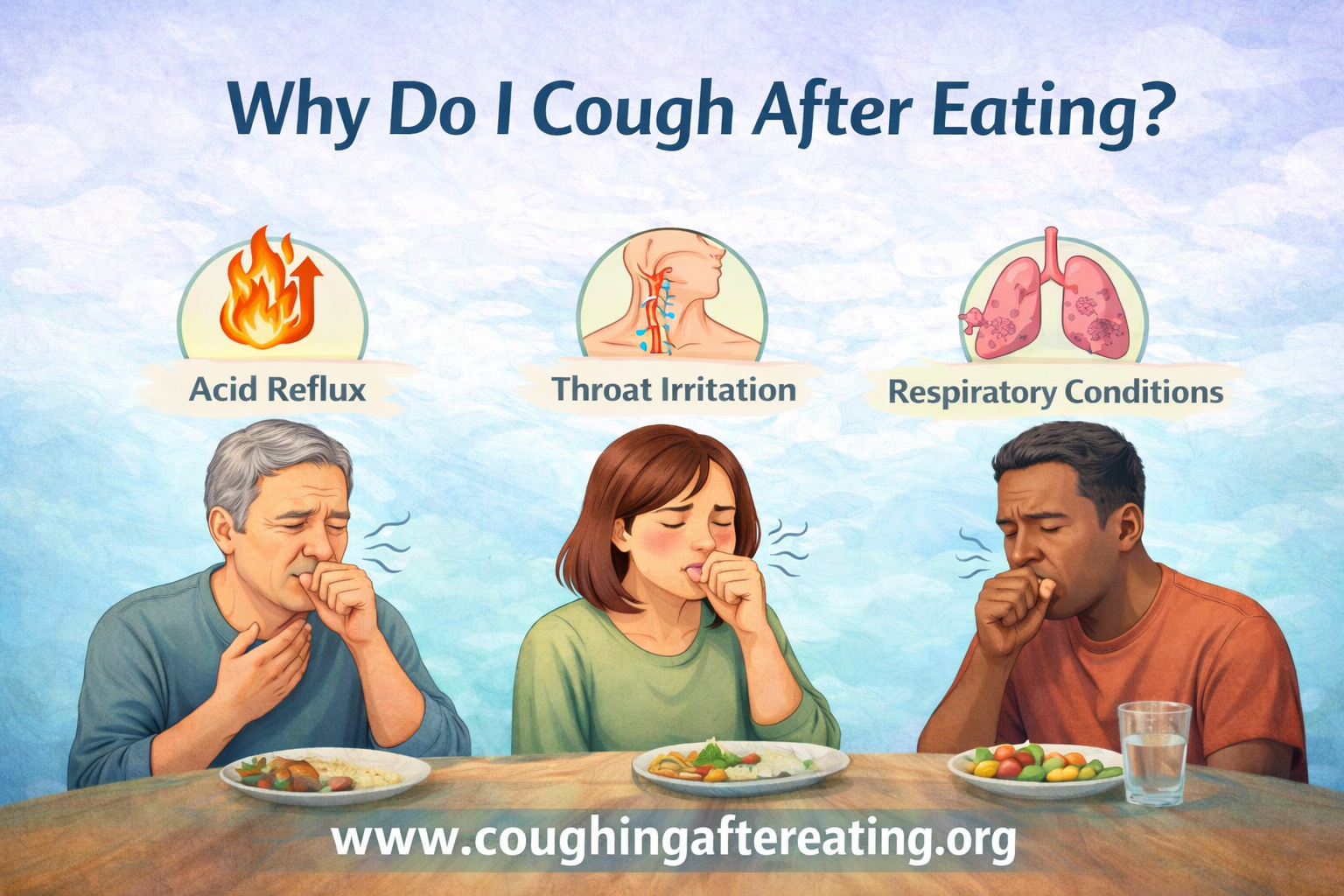
Why do I cough after eating? Causes explained clearly
Coughing after eating is usually caused by reflux, swallowing problems, or airway irritation.
It can feel confusing, especially when coughing after eating happens repeatedly without an obvious reason. For some people, it occurs occasionally when food goes down the wrong way. For others, it becomes a persistent symptom that starts to interfere with daily life.
The important thing to understand is that coughing after eating is not a condition by itself, but a symptom with several possible causes. These can range from mild and temporary triggers to underlying digestive or airway-related issues.
Common causes of coughing after eating include acid reflux, swallowing difficulties, postnasal drip, food sensitivities, or irritation in the throat and airways. In many cases, it is not just about the food itself, but how the body reacts during swallowing, digestion, or airway protection.
This page brings together the most common causes in one place, helping you understand what might be happening in your body and how to interpret your symptoms more clearly.
You can explore related guides on symptoms, triggers, and prevention as you go deeper, but this page gives you the full picture first.
Pattern signal
Immediate cough → likely swallowing issue
Delayed cough → more likely digestive cause
Mixed or persistent cough → possible airway sensitivity
Digestive causes of coughing after eating
Digestive causes of coughing after eating are among the most common, but they are often misunderstood because the cough does not usually happen during swallowing. Instead, it tends to appear after a meal, sometimes within minutes, depending on how the stomach and esophagus respond to food.
In these cases, the underlying issue is not food entering the airway, but irritation caused by stomach contents moving upward or affecting the throat. This can trigger the cough reflex even without obvious digestive symptoms, which is why many people do not immediately connect their cough to digestion.
A key pattern to look for is timing. If coughing happens after eating rather than during swallowing, especially after larger meals or certain trigger foods, a digestive cause becomes more likely.
Acid reflux and GERD
Pattern signal:
Coughing starts a few minutes after eating, especially after large or trigger meals.
Reflux-related coughing is one of the most common patterns. If you are unsure whether acid reflux could be responsible, see can acid reflux cause coughing after eating.
Acid reflux occurs when stomach acid flows back up into the esophagus. When this acid reaches the throat, it can irritate the airway and trigger a cough reflex.
This is especially common after large meals, spicy foods, fatty foods, or lying down soon after eating. The cough may not always be immediate and can sometimes appear a few minutes after finishing a meal.
If reflux is suspected, why GERD causes coughing after eating helps explain how acid irritation leads to coughing and why symptoms often appear after meals rather than during swallowing.
This pattern is well recognised in reflux-related cough, where timing after meals provides an important clue to the underlying cause.
If coughing tends to appear a few minutes after eating, a digestive cause such as reflux becomes more likely. Learn more in why GERD causes coughing after eating.
For a deeper explanation of how reflux triggers coughing, see can acid reflux cause coughing after eating.
Silent reflux (LPR)
Pattern signal:
Coughing with throat irritation, hoarseness, or throat clearing, often without heartburn.
Silent reflux, also known as laryngopharyngeal reflux, affects the throat more than the chest. Unlike typical reflux, it may not cause heartburn, which makes it harder to identify.
Instead, it can lead to throat irritation, hoarseness, and persistent coughing after eating. Many people with this condition experience frequent throat clearing or a sensation of something stuck in the throat.
In many cases, the symptom pattern feels more like a throat problem than a stomach problem, which is one reason silent reflux is often overlooked at first.
Because symptoms are often subtle, silent reflux coughing after eating helps explain why throat irritation occurs even without obvious reflux symptoms.
If coughing is associated with throat clearing, hoarseness, or a sensation in the throat without typical heartburn, silent reflux becomes more likely. Learn more in silent reflux coughing after eating.
Delayed digestion and reflux patterns
Pattern signal:
Cough develops later after meals rather than immediately, often gradual.
Sometimes, food stays in the stomach longer than expected, increasing the chance of reflux. This can lead to coughing that appears later rather than immediately after eating.
In such cases, the timing of the cough becomes an important clue. A delayed cough often points toward digestive causes rather than swallowing issues, especially in conditions like delayed gastric emptying.
This pattern can be easy to miss because the cough does not occur during the meal itself, but develops gradually afterward.
This pattern is explained in delayed gastric emptying and reflux cough.
If coughing appears noticeably after a meal, delayed digestion and reflux become more likely causes. Learn more in delayed gastric emptying and reflux cough.
Digestive causes of coughing after eating often follow a different pattern compared to swallowing-related issues. Instead of happening during a meal, the cough usually appears shortly afterward, especially after larger meals or certain trigger foods.
In many cases, this is due to irritation caused by stomach contents affecting the esophagus or throat, sometimes without obvious symptoms like heartburn.
If your cough tends to occur after eating and is linked to throat irritation, hoarseness, or a sour taste, a digestive cause such as reflux becomes more likely.
Swallowing-related causes (airway protection issues)
Swallowing-related causes of coughing after eating are closely linked to how the body protects the airway during eating and drinking. When everything works normally, swallowing and breathing are carefully coordinated to ensure that food and liquid go into the esophagus while the airway remains closed.
If this coordination is disrupted, even briefly, small amounts of food or liquid can approach or enter the airway. The body responds immediately with a cough reflex to clear it and prevent it from reaching the lungs. This is a protective response and is often sudden and noticeable.
A key pattern to recognise is timing. Coughing that happens during swallowing or within seconds of eating usually points toward an airway protection or swallowing-related issue rather than a digestive cause.
Aspiration when eating
Pattern signal:
Sudden coughing during swallowing, especially with liquids or mixed textures.
Aspiration occurs when food or liquid enters the airway instead of going down the esophagus. This immediately triggers coughing as the body tries to clear the airway.
This type of coughing often happens during swallowing, especially with liquids or mixed textures. The cough tends to be sudden and can feel forceful because it is a protective reflex designed to prevent material from entering the lungs.
Aspiration when eating and coughing causes helps clarify why the body reacts so quickly in these situations.
If coughing happens immediately during swallowing, especially with liquids, it is more likely related to airway protection or swallowing coordination. Learn more in aspiration when eating and coughing causes.
Food going down the wrong way
Pattern signal:
Sudden, intense coughing during a meal, often when eating quickly or talking.
Even without a medical swallowing disorder, small amounts of food can occasionally enter the airway. This can happen if you eat too quickly, talk while eating, or do not chew properly.
When this happens, coughing tends to be sudden and intense, often during the meal itself. It may feel like choking for a brief moment, followed by relief once the airway clears.
This is a very common experience and does not always indicate a medical problem, but repeated episodes may suggest a pattern worth paying attention to.
Why food goes down the wrong way and causes coughing after eating helps explain how these everyday habits trigger the cough reflex.
Sudden coughing during a meal, particularly when eating quickly or talking, usually points toward food entering the airway rather than a digestive issue. Learn more in why food goes down the wrong way and causes coughing after eating.
Swallowing coordination issues
Pattern signal:
Repeated coughing during swallowing, especially with liquids or specific textures.
Some people experience subtle swallowing difficulties that are not always obvious. These can lead to repeated coughing episodes after eating, especially with certain textures or liquids.
In these cases, the coordination between breathing, swallowing, and airway closure is slightly disrupted. Even a small delay in timing can allow food or liquid to approach the airway, triggering coughing.
If coughing happens consistently during swallowing, it may indicate an underlying coordination issue rather than a digestive cause, and dysphagia and coughing after eating helps explain how swallowing coordination affects airway protection.
If coughing occurs repeatedly during swallowing, especially with liquids or mixed textures, a coordination issue becomes more likely than a digestive cause. Learn more in dysphagia and coughing after eating.
Swallowing-related causes of coughing after eating usually happen at the moment of swallowing or immediately afterward. Unlike digestive causes, the cough is often sudden and triggered as the body reacts to protect the airway.
In these situations, even small amounts of food or liquid entering the airway can stimulate a strong cough reflex. This response is protective and helps prevent material from reaching the lungs, but repeated episodes may indicate an underlying coordination or swallowing issue.
If your coughing consistently occurs during eating, especially with liquids or certain textures, it is more likely related to how swallowing is functioning rather than digestion.
Recognizing this pattern is important, as it helps distinguish airway protection issues from other causes and points toward the need for more focused evaluation if symptoms persist.
Airway and throat irritation causes
Airway and throat irritation causes of coughing after eating are often overlooked because they do not involve swallowing problems or digestion directly. Instead, the cough is triggered by sensitivity in the throat or upper airway itself.
In these cases, the throat may already be irritated due to mucus, inflammation, or heightened sensitivity. When you eat, the movement of swallowing, changes in temperature, or contact with food can stimulate this sensitive area and trigger a cough reflex.
Unlike swallowing-related causes, the cough does not usually feel like something went down the wrong way. Unlike digestive causes, it is not driven by stomach contents. Instead, it is often linked to sensations such as tickling, mucus in the throat, or a constant need to clear the throat.
A key pattern to recognise is that coughing may occur during or after eating, often alongside throat clearing or irritation, rather than being strictly tied to swallowing timing or delayed digestion.
Postnasal drip and throat irritation
Pattern signal:
Coughing with throat clearing, mucus sensation, or a tickling feeling, often during or after eating.
Postnasal drip occurs when mucus from the nose and sinuses drips down the back of the throat. This can make the throat more sensitive and prone to coughing.
Eating can stimulate this sensitivity further, triggering a cough reflex. In some people, the act of swallowing itself increases awareness of mucus in the throat, making the urge to cough or clear the throat stronger.
Postnasal drip and coughing after eating helps explain why throat irritation worsens during or after meals.
If coughing is accompanied by throat clearing, mucus sensation, or a tickling feeling, airway irritation becomes a more likely cause. Learn more in postnasal drip and coughing after eating.
Chronic throat sensitivity
Pattern signal:
Cough triggered by multiple minor stimuli, including food, temperature, or normal swallowing.
Some people develop a heightened cough reflex, where even minor irritation can trigger coughing. This can be due to repeated exposure to reflux, allergens, environmental irritants, or past infections.
In such cases, coughing after eating is not caused by the food itself but by an already sensitive airway reacting more easily than usual.
This type of cough can feel persistent and may be triggered by multiple factors, including temperature changes, certain textures, or even normal swallowing.
Chronic cough reflex sensitivity and throat irritation helps explain why even minor triggers lead to repeated coughing episodes.
If coughing is triggered by multiple minor stimuli rather than specific foods, an underlying sensitivity of the airway is more likely. Learn more in chronic cough reflex sensitivity and throat irritation.
Airway and throat irritation causes of coughing after eating are often related to increased sensitivity rather than a single triggering event. In these cases, the cough is not caused by food entering the airway or acid moving upward, but by an already irritated throat reacting more easily.
This type of cough may feel persistent and can be triggered by relatively minor stimuli, including certain foods, temperature changes, or even normal swallowing. It is often accompanied by symptoms such as throat clearing, a tickling sensation, or a feeling of mucus in the throat.
If coughing after eating is frequent but not clearly linked to swallowing or digestion, airway sensitivity becomes a likely explanation.
Recognizing this pattern helps separate irritation-based causes from other types and provides a clearer direction for understanding and managing the symptom.
Food-related triggers and sensitivities
Food-related triggers and sensitivities can play a more complex role in coughing after eating than many people expect. Unlike swallowing-related causes, which tend to produce an immediate and clearly timed cough, food triggers often create a more subtle pattern. The reaction is not always about food going down the wrong way, but about how the body responds to what you have eaten.
In some cases, certain foods can irritate the throat directly, making it more sensitive and prone to coughing. In others, they may increase mucus production or trigger mild inflammation, which creates a lingering urge to cough or clear the throat. These responses can vary from person to person, which is why the same food may cause symptoms in one person but not in another.
Another important feature of food-related triggers is that the timing is not always predictable. Coughing may happen immediately after eating, or it may develop gradually as the throat becomes irritated. This can make the pattern harder to recognise, especially when compared with more obvious causes like reflux or swallowing issues. Over time, however, many people notice that their symptoms tend to repeat after specific meals, ingredients, or food types.
Food sensitivities and intolerances can also contribute to this pattern. Even when there is no strong allergic reaction, the body may still respond in ways that affect the airway, such as causing mild swelling, discomfort, or increased secretions. These effects are often overlooked because they do not feel severe, but they can still be enough to trigger coughing after eating.
The key distinction here is consistency. If coughing appears repeatedly after certain foods but not others, it suggests that the trigger is linked to the food itself rather than the act of eating or swallowing. Identifying these patterns can be one of the most useful steps in understanding why the symptom is happening.
By paying closer attention to what you eat and how your body responds afterward, you can begin to narrow down potential triggers. This does not always require major dietary changes. In many cases, small adjustments based on observed patterns can significantly reduce coughing episodes and make symptoms easier to manage.
Food allergies and intolerances
Pattern signal:
Coughing consistently after specific foods, often with throat irritation or mucus.
Food allergies can cause throat irritation, swelling, or increased mucus production, all of which may lead to coughing.
Even milder food intolerances can trigger symptoms like throat discomfort or a need to clear the throat repeatedly. In some cases, the reaction may not be immediate but still shows a consistent pattern with certain foods.
Food allergies and coughing after eating helps explain how these reactions affect the airway.
If coughing occurs consistently after specific foods but not others, food allergies or intolerances become a more likely cause. Learn more in food allergies and coughing after eating.
Specific food triggers
Pattern signal:
Cough linked to certain foods like spicy, fatty, or temperature extremes.
Some foods are more likely to trigger coughing after eating than others. These include:
- Spicy foods
- Fried or fatty meals
- Very cold or very hot drinks
- Dairy in some individuals
These foods may worsen reflux, increase mucus production, or irritate the throat.
Foods that cause coughing after eating can help you identify which triggers are most relevant to your symptoms.
If coughing happens consistently after specific foods but not others, food-related triggers are a likely factor. Learn more in foods that cause coughing after eating.
Food-related triggers and sensitivities can cause coughing after eating in more subtle ways compared to other causes. Instead of a clear mechanical trigger, the reaction often comes from how the body responds to certain foods.
In some cases, this may involve irritation of the throat, increased mucus production, or a mild immune response that makes the airway more sensitive. The cough may not happen every time, but can appear consistently with specific foods or patterns.
If your symptoms seem linked to particular meals or ingredients rather than the act of swallowing or digestion itself, food triggers become a likely factor.
Paying attention to these patterns can help you identify potential triggers and make simple adjustments that reduce coughing episodes over time. To explore this further, see foods that cause coughing after eating.
Symptom patterns that help identify the cause
Symptom patterns can provide some of the clearest clues to understanding why coughing after eating happens. While different causes may produce similar symptoms, the way the cough appears, including its timing, triggers, and type, often helps distinguish between them.
Looking at the symptom in isolation can be misleading. However, when you pay attention to patterns such as whether the cough happens immediately or later, whether it is triggered by liquids or specific foods, or whether it feels wet or dry, a clearer picture begins to form.
This approach helps shift the focus from guessing the cause to recognising consistent signals in how your body responds after eating.
Immediate coughing after eating
Pattern signal:
Cough starts within seconds of swallowing.
If coughing starts right after swallowing, it often points toward a swallowing or airway issue rather than digestion.
This type of cough usually occurs within seconds and is closely linked to the act of swallowing itself. It may feel sudden and protective, especially if something briefly enters or irritates the airway.
Why do I cough immediately after eating helps clarify how timing relates to the underlying cause.
Coughing that starts immediately after swallowing is more likely related to airway coordination than digestion. Learn more in why do I cough immediately after eating.
Coughing after drinking liquids
Pattern signal:
Liquids trigger coughing more than solid foods.
If liquids trigger coughing more than solid foods, it may suggest a coordination issue during swallowing or a sensitivity in the airway.
Liquids move quickly and require precise timing between swallowing and airway closure. Even a slight delay in coordination can trigger coughing.
Why do I cough after drinking liquids can help explain why liquids are more difficult to control during swallowing.
If liquids trigger coughing more than solid foods, it often points toward a swallowing coordination issue. Learn more in why do I cough after drinking liquids.
Frequent throat clearing after eating
Pattern signal:
Repeated throat clearing with irritation or mucus sensation.
Repeated throat clearing can be a sign of irritation from reflux or postnasal drip rather than a direct airway blockage.
This symptom often feels less forceful than coughing but can occur frequently and become persistent over time.
Why do I keep clearing my throat after eating can help explain why this symptom often accompanies coughing.
Frequent throat clearing after meals often indicates irritation rather than a true airway blockage. Learn more in why do I keep clearing my throat after eating.
Wet vs dry cough patterns
Pattern signal:
Wet cough suggests mucus, dry cough suggests irritation or reflux.
The type of cough also matters.
A wet cough usually suggests mucus or airway involvement, while a dry cough more often points toward irritation, reflux, or throat sensitivity.
Wet vs dry cough after eating can help you interpret what your symptoms are suggesting.
Recognizing these symptom patterns helps turn a confusing symptom into something more structured and understandable. While the causes may overlap, the timing, triggers, and type of cough often provide strong clues.
When you combine these observations, it becomes much easier to narrow down the most likely cause and focus on the right explanation.
When coughing after eating may be serious
In some cases, coughing after eating can indicate a more significant issue, especially if it is persistent, worsening, or associated with other symptoms.
A brief or occasional cough is usually not concerning. However, certain patterns suggest that further attention may be needed.
Warning signs to watch for
- Frequent choking episodes
- Difficulty swallowing
- Food feeling stuck in the throat
- Unexplained weight loss
- Persistent chest discomfort
- Recurrent coughing that is getting worse over time
These symptoms may indicate an underlying swallowing disorder, significant reflux, or another medical condition that requires proper evaluation.
If these signs are present, it is important to understand when coughing after eating is serious.
How to identify your specific cause
Because multiple conditions can cause coughing after eating, the pattern of your symptoms matters more than any single sign.
Instead of focusing on one symptom alone, it is more helpful to look at how your symptoms behave over time.
Pay attention to:
- When the cough starts (immediate vs delayed)
- What triggers it (specific foods, liquids, or eating habits)
- Associated symptoms (heartburn, throat clearing, mucus, irritation)
If your cough happens immediately during swallowing, it is more likely related to airway or swallowing issues.
If it appears later, digestive causes like reflux may be involved.
If it occurs across many situations without a clear trigger, airway sensitivity may be the key factor.
By observing these patterns carefully, you can narrow down the most likely cause and focus on the right solution.
Each section above links to a detailed guide that explains the condition in depth and helps you take the next step.
Looking at different eating situations can also provide useful clues about what is triggering your symptoms over time.
What to do next
Start by identifying your pattern.
Then explore the most relevant sections above and follow the detailed guides linked throughout this page.
You do not need to figure everything out at once. Instead, use this page as a reference point and return to it as your understanding becomes clearer.
Revisit the sections as needed to reassess your symptoms and connect them with the most relevant cause.
Final thoughts
Coughing after eating can have several possible causes, and in many cases, it is the pattern of symptoms rather than a single sign that provides the most useful insight.
Whether it is related to digestion, swallowing, airway sensitivity, or specific food triggers, understanding what your body is responding to is the key to finding the right solution.
While occasional coughing may not be a concern, persistent or unexplained symptoms should not be ignored.
By exploring the sections above and following the detailed guides linked throughout, you can move from confusion to clarity and take the next steps with more confidence.
Common questions about coughing after eating
What causes coughing after eating?
Common causes of coughing after eating include acid reflux, swallowing coordination issues, airway irritation, or mucus-related conditions. The timing of the cough helps narrow the cause. Immediate coughing often points to swallowing or airway triggers, while delayed coughing is more often linked to reflux or digestion.
Why do I cough immediately after eating?
Coughing immediately after eating usually happens when something briefly irritates or enters the airway during swallowing. This can occur if swallowing timing is slightly off or if food or liquid goes toward the airway instead of the esophagus.
Why do I cough a few minutes after eating?
Coughing a few minutes after eating is more commonly linked to reflux. Stomach contents can move upward after a meal and irritate the throat or airway, triggering a cough. This type of cough often appears 5 to 30 minutes after eating.
Can acid reflux cause coughing after eating?
Yes, acid reflux can cause coughing after eating. When stomach acid or contents move upward, they can irritate the esophagus or throat and trigger a cough reflex, even without heartburn.
Why do I cough after drinking liquids?
Coughing after drinking liquids is often related to swallowing coordination. Thin liquids move quickly and require precise timing, so even a small delay in airway closure can trigger coughing.
Is coughing after eating serious?
Coughing after eating is usually not serious if it happens occasionally. However, it may need medical attention if it is frequent, worsening, or associated with symptoms such as choking, weight loss, chest pain, or difficulty swallowing.
How do I know if my cough is from reflux or swallowing problems?
Timing is the most useful clue. Coughing during or immediately after swallowing suggests a swallowing or airway issue. Coughing that starts later after a meal is more likely related to reflux or irritation building over time.
Why do I keep clearing my throat after eating?
Throat clearing after eating is often caused by mild irritation in the throat. This can be due to reflux reaching the upper airway or increased mucus activity, leading to a repeated need to clear the throat rather than a strong cough.
What foods can trigger coughing after eating?
Foods that commonly trigger coughing include spicy foods, fatty meals, acidic foods, dairy for some individuals, and very dry or crumbly foods. These can either irritate the throat, increase reflux, or affect swallowing.
When should I see a doctor for coughing after eating?
You should seek medical advice if coughing after eating happens frequently, becomes more severe, or is associated with choking, food sticking, unexplained weight loss, or repeated chest infections. These may indicate an underlying condition that needs evaluation.